
Systematic Does Not Mean Robust

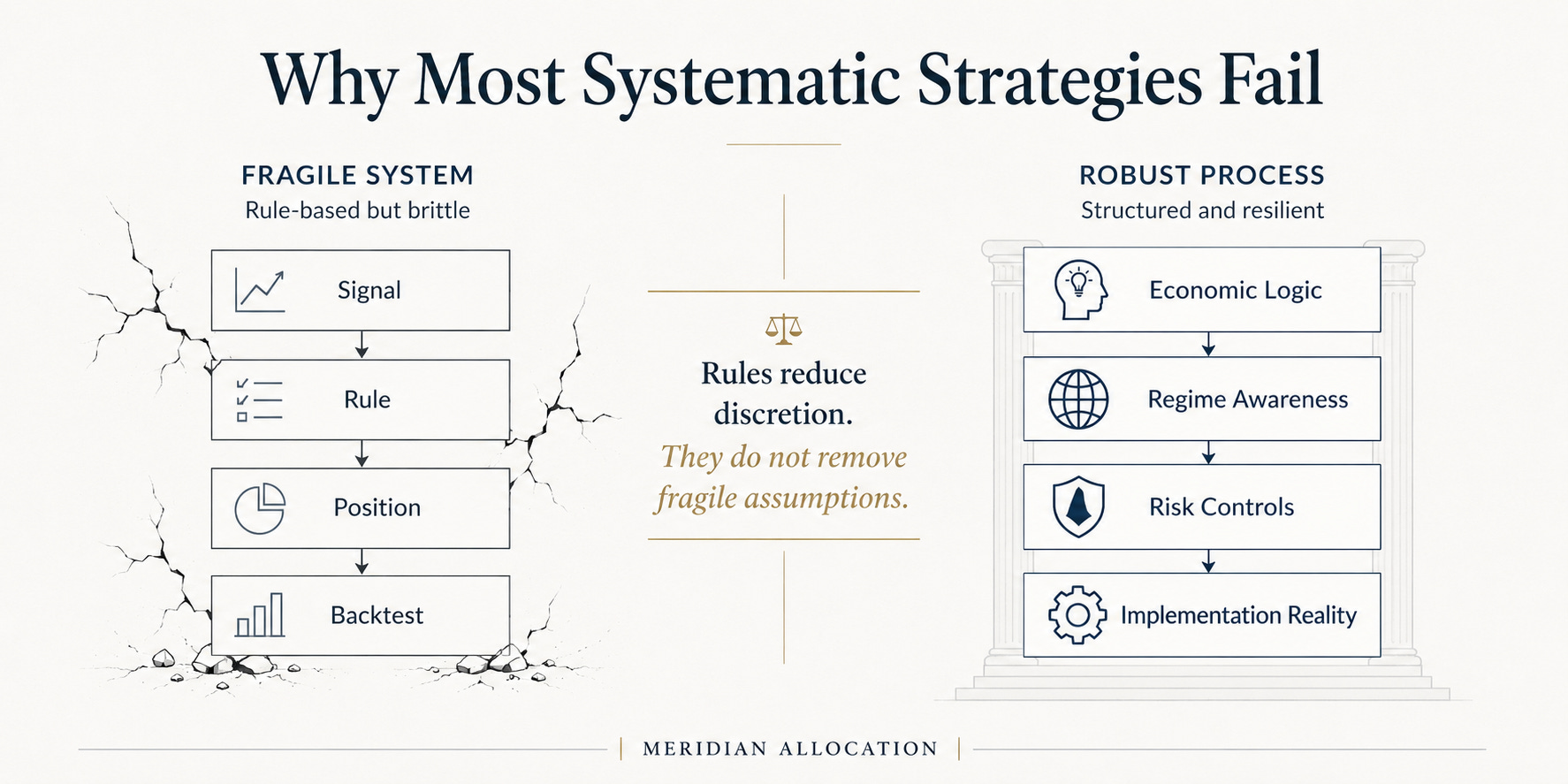
A strategy can be systematic and still be fragile.
Rules can remove improvisation.
They can reduce emotional decision-making.
They can make a process repeatable, testable, and easier to evaluate.
But rules do not make a strategy robust by default.
A weak idea expressed systematically is still a weak idea.
A fragile assumption coded into rules is still fragile.
A beautiful backtest built on unstable relationships is still vulnerable when capital is deployed.
This is where many investors misunderstand systematic investing.
They see a rules-based process and assume discipline.
They see a backtest and assume evidence.
They see precision and assume reliability.
But systematic strategies usually do not fail because they lacked rules.
They fail because the rules were built on foundations that could not survive changing conditions.
The question is not whether a strategy is systematic.
The question is whether the system is structurally robust enough to survive contact with reality.
How a Systematic Process Actually Works
A systematic process is a structured method for converting information into decisions.
At its simplest, the process follows a chain:
Data comes in, signals are generated, rules interpret those signals, and portfolio actions follow.
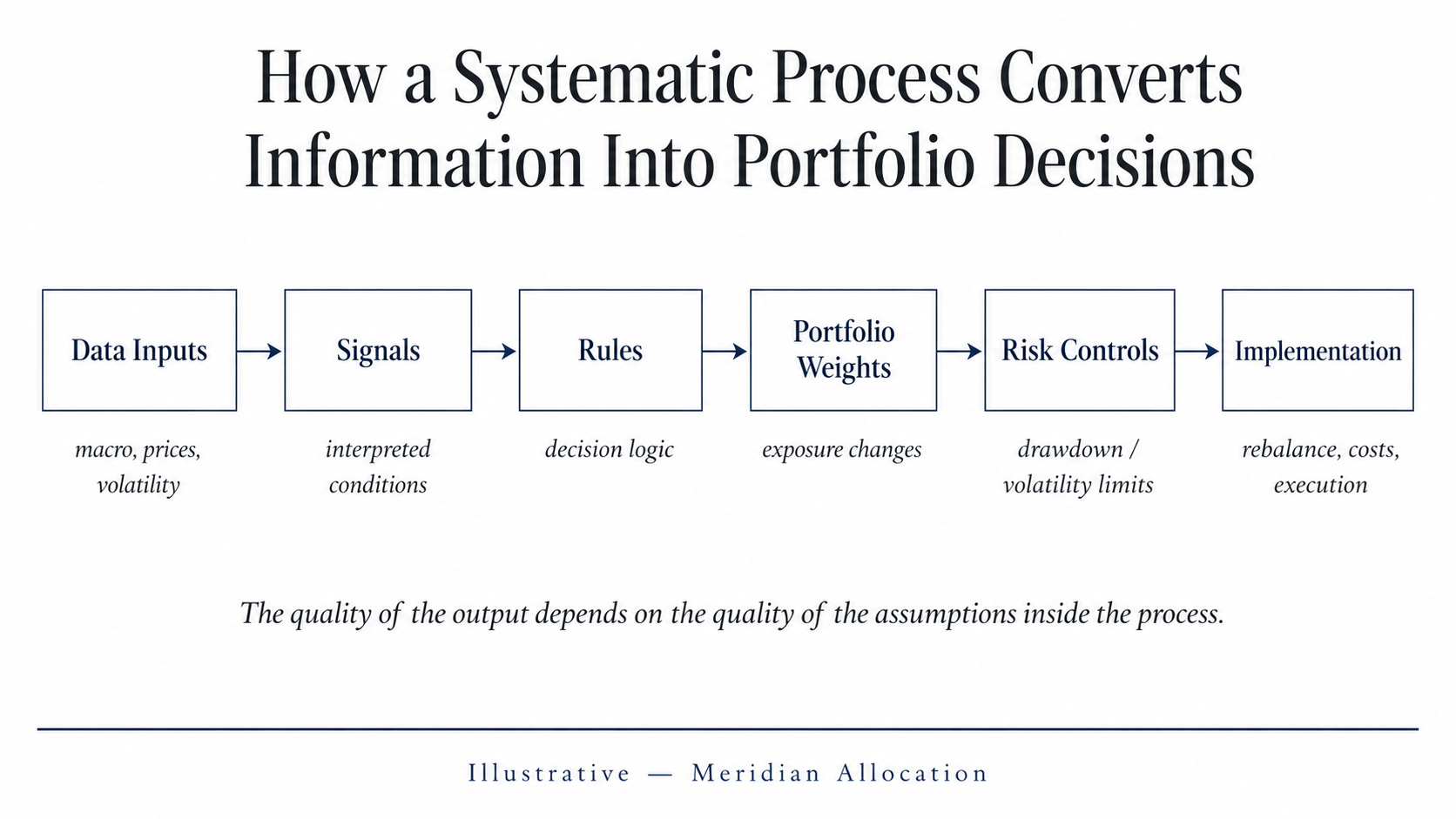
Those actions may include changing asset weights, rebalancing exposures, reducing risk, increasing risk, or moving capital between different parts of the portfolio.
The appeal is clear.
A systematic process reduces improvisation. It creates consistency. It gives the investor a way to evaluate decisions against a defined framework rather than relying on mood, narrative, or short-term market pressure.
In portfolio construction, this matters.
Without a process, every new headline can feel like a reason to change positioning. Every drawdown can create doubt. Every rally can create pressure to chase exposure.
A systematic framework is meant to prevent that.
But structure only helps if the structure is sound.
A process can be disciplined and still wrong. It can be repeatable and still poorly designed. It can be rules-based and still exposed to the wrong environment.
Systematic investing is not valuable because it uses rules.
It is valuable only when the rules express durable logic.
Why Systematic Strategies Are Attractive
The attraction is understandable.
Investors want a way to remove emotion from decision-making.
A rules-based system appears to offer that.
It can define when to enter, when to exit, how much to allocate, how often to rebalance, and how to manage risk. It can reduce the temptation to react to every market move. It can force the investor to follow a plan when conditions become uncomfortable.
That is a real advantage.
For serious portfolio design, repeatability matters. A framework that behaves differently every time the market becomes volatile is not a framework. It is discretion with a spreadsheet attached.
But the strength of systematic investing is also its danger.
Once a rule exists, it can feel objective. Once a backtest looks good, it can feel validated. Once the system produces clean outputs, it can feel more reliable than it really is.
This is the trap.
Systematic does not mean objective in the way many investors assume.
The human judgment does not disappear. It moves upstream.
Someone chooses the data.
Someone defines the signal.
Someone sets the thresholds.
Someone decides the rebalance cadence.
Someone chooses the risk controls.
Someone decides what historical period matters.
A systematic strategy is never free from judgment.
It simply formalizes the judgment into rules.
Why Most Systematic Strategies Fail
Most systematic strategies fail because they confuse historical fit with structural resilience.
They are built to explain what already happened rather than survive what may happen next.
The failure usually appears in several forms.
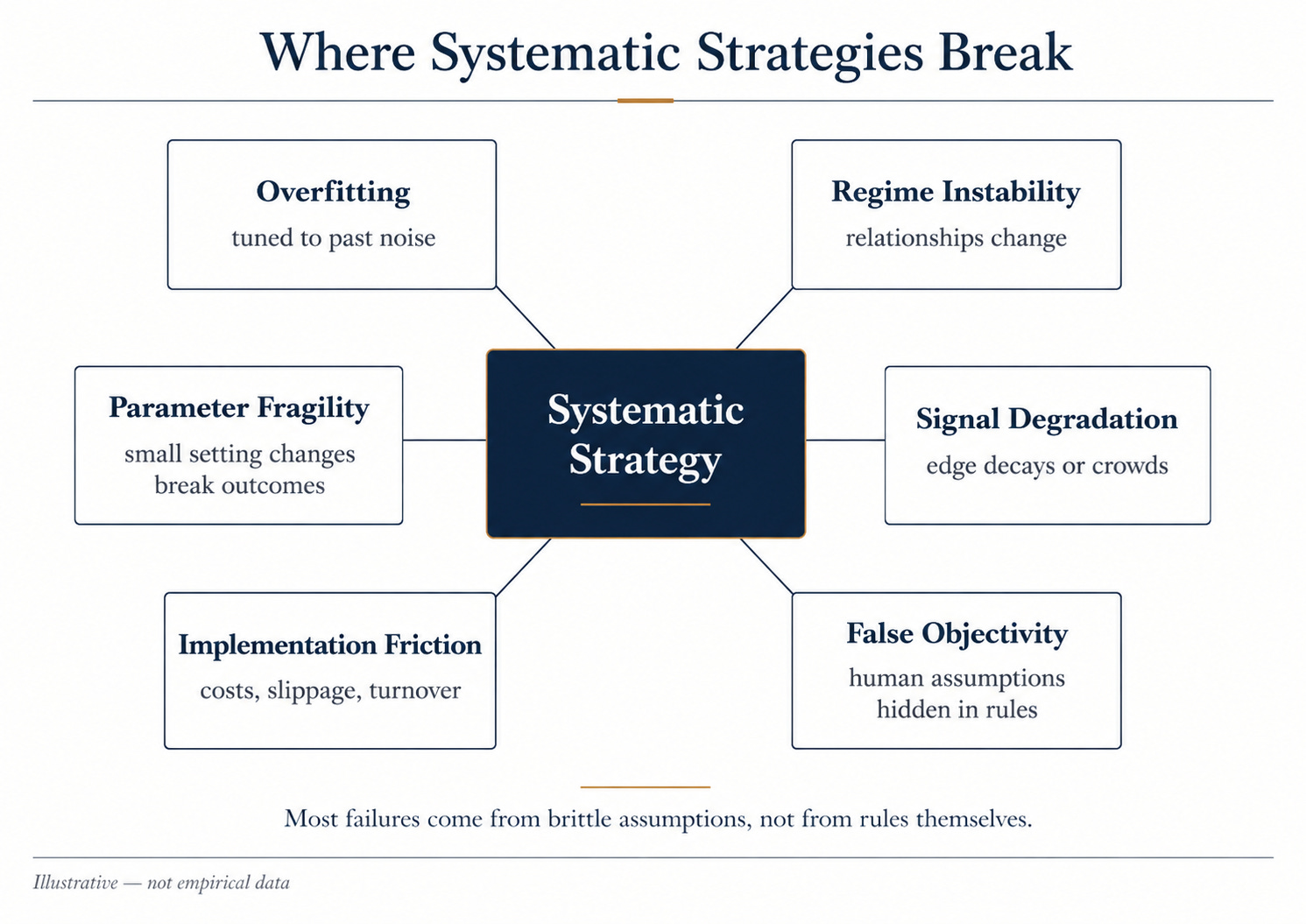
1. Overfitting: Winning the Exam It Already Saw
Overfitting happens when a strategy is tuned too closely to historical data.
The system is adjusted again and again until the backtest looks attractive. A filter is added. A threshold is modified. A lookback window is changed. A rule is included because it improved performance in the sample.
Eventually, the strategy begins to fit noise rather than structure.
The backtest improves, but the live strategy becomes weaker.
This is one of the most common failure modes because it is psychologically seductive. Every adjustment appears reasonable in isolation. Each one seems to make the system more refined.
But too much refinement can be a warning sign.
A strategy that only works with highly specific settings may not be capturing a durable relationship. It may simply be memorizing the past.
In portfolio terms, this matters because overfit systems often fail exactly when the investor needs reliability. The model looked stable historically because it was designed around historical quirks. When the market changes, the apparent edge disappears.
The result is not just lower returns.
It can be higher turnover, worse drawdowns, mistimed exposure changes, and a loss of confidence in the process itself.
A strategy that requires perfect historical calibration is not robust.
It is fragile with good marketing.
2. Regime Instability: The Environment Changes
Many systematic strategies are built around relationships that worked in one environment.
The problem is that markets do not operate under one environment forever.
Inflation regimes change.
Rate regimes change.
Policy reaction functions change.
Liquidity conditions change.
Correlations change.
Asset leadership changes.
A signal that worked during falling rates may struggle when inflation is persistent. A risk model built during stable correlations may underestimate drawdowns when correlations converge. A trend rule that worked in one volatility regime may become too slow or too reactive in another.
This is not a minor issue.
For allocation strategies, regime instability is often the central problem.
A system may look excellent because it was tested through a period where its assumptions were rewarded. But if those assumptions depend on a particular macro backdrop, the strategy may not be robust across environments.
This is why a serious systematic process must ask:
What environment made this rule work?
If the answer is too narrow, the system is vulnerable.
The goal is not to build rules that perform equally well everywhere. That is unrealistic. The goal is to understand how the system is expected to behave across different regimes and where its vulnerabilities are likely to appear.
A strategy that does not understand its own regime dependence is not disciplined.
It is blind.
3. Parameter Fragility: When Small Changes Break the System
A robust strategy should not depend on one perfect setting.
If a moving average works at 10 months but fails at 9 or 11, that is a problem. If a volatility threshold works at 15% but collapses at 14% or 16%, that is a problem. If a rebalance rule only works on one exact calendar timing, that is a problem.
These are signs of parameter fragility.
In live portfolio management, parameters are not sacred. They are approximations. They represent a way of expressing a broader idea.
If the broader idea is sound, nearby parameter choices should produce broadly similar behaviour.
Not identical outcomes. But similar logic.
When small changes create large differences, the system may be more dependent on calibration than on principle.
This has real portfolio consequences.
A fragile parameter can cause unnecessary turnover. It can push the strategy in and out of exposure too frequently. It can make the system highly sensitive to noise. It can create a false sense of precision where none exists.
Serious systematic design should prefer robust regions over perfect points.
The question is not:
Which parameter produced the best backtest?
The better question is:
Does the logic survive across reasonable parameter ranges?
4. Signal Degradation: Edges Do Not Last Forever
Some signals work until they become crowded, obvious, or too easy to replicate.
If enough capital responds to the same relationship, the opportunity can be competed away. Markets may price it earlier, and crowded exits can become more difficult when conditions reverse.
A signal that worked historically may reflect a durable risk premium, a behavioural pattern, a temporary inefficiency, or a data-mined relationship. The investor has to know the difference.
For long-only allocation frameworks, broad regime classification does not need to be secret. But the system should not assume any relationship works permanently simply because it appeared historically.
Markets adapt. Signals weaken. Relationships change.
5. Implementation Reality: Backtests Do Not Trade Themselves
Even a reasonable strategy can fail in implementation.
Backtests often underestimate the cost of turning rules into live portfolio actions.
Transaction costs matter.
Slippage matters.
Bid-ask spreads matter.
Liquidity matters.
Taxes can matter.
Turnover matters.
Rebalance timing matters.
A model may look strong before costs but mediocre after them. A strategy may appear stable at monthly data frequency but become messy when execution dates, signal lags, and live pricing are included. A high-turnover system may look attractive in theory while giving up too much in friction.
This is where many systematic strategies become less impressive.
The paper version assumes clean execution. The live version faces constraints.
For portfolio allocation, implementation quality is not a detail. It is part of the strategy.
If a system requires constant trading, exact fills, low friction, and perfect timing, it may not be suitable for real investors.
A robust strategy should be designed with implementation in mind from the beginning.
The portfolio should not require theoretical conditions to survive.
It should be built for the market that actually exists.
6. False Objectivity: Rules Still Contain Human Bias
Systematic strategies reduce emotional decision-making, but they do not remove human judgment.
They move it upstream.
Someone chooses the data, signals, thresholds, rebalance cadence, risk controls, and objective function. Those choices shape the final system.
A strategy optimized for return may carry unacceptable drawdowns. A strategy optimized for smooth historical performance may be overfit. A strategy optimized over one historical window may fail in another regime.
Systematic outputs are not neutral.
They reflect assumptions.
The goal is not to eliminate judgment. It is to make judgment explicit, disciplined, and structurally defensible.
What Robust Systematic Thinking Looks Like

A more serious systematic process looks different from a backtest built to impress.
It starts with logic, not performance.
The rules should have an economic or behavioural rationale. They should be interpretable enough that the investor understands what the system is trying to capture. They should be tested across reasonable parameter ranges rather than optimized around one perfect setting.
The process should also recognize that regimes change.
A strategy designed for real allocation must understand that asset behaviour is conditional. Correlations are not fixed. Inflation and growth environments matter. Policy conditions matter. Liquidity conditions matter.
Robustness also requires realistic implementation assumptions.
A system that ignores costs, turnover, slippage, liquidity, or rebalance timing is not finished. It is a prototype.
Most importantly, serious systematic thinking prioritizes survivability over cosmetic performance.
A smooth backtest is not the objective.
A process that remains coherent under stress is.
The strongest systems are not the most complex. They are the ones where the logic, calibration, implementation, and risk controls all point in the same direction.
Why This Matters for Serious Investors
The practical lesson is simple.
Do not confuse rules with robustness.
A strategy can be systematic and still be overfit. It can be disciplined and still be poorly specified. It can be precise and still be wrong.
Before trusting a systematic process, investors should ask:
What is the logic behind the rules?
Does the system depend on one narrow historical period?
Do small parameter changes break the outcome?
What happens when the macro regime changes?
Are transaction costs and turnover realistic?
Does the strategy control drawdowns, or just report them after the fact?
Is the system understandable enough to trust under pressure?
The real test is not whether the backtest looks good.
The real test is whether the process remains defensible when conditions stop resembling the past.
That is when strategy design matters.
Meridian Allocation is rules-based, but it is not built on the illusion that rules solve everything.
The point of rules is not to create false precision.
The point is to create discipline.
Meridian uses a structured macro allocation process to classify the broad environment, translate that into long-only ETF portfolio positioning, and apply risk controls.
The framework is designed around broad regime logic, interpretable decisions, and practical implementation rather than black-box optimization or fragile precision.
It does not claim that systematic means infallible.
It does not promise perfect adaptation.
It does not assume that a backtest alone proves robustness.
Instead, Meridian is built around a more restrained premise:
a disciplined framework should be understandable, repeatable, risk-aware, and designed for changing conditions.
That is a different standard from algorithmic mystique.
It is also a more useful one for serious allocation.

Most systematic strategies do not fail because rules are useless.
They fail because brittle rules are mistaken for robust process.
A system is only as strong as the assumptions underneath it. If the logic is weak, the parameters fragile, the regime assumptions unrealistic, or the implementation impractical, the rules will not save it.
They will simply automate the weakness.
The question is not whether a strategy is systematic.
The question is whether the system is built on logic that can survive reality.
Follow the publication, read the related framework pieces, review archived examples, and join the waitlist for Meridian Allocation if this way of thinking is relevant to how you invest.
Because serious systematic investing is not about having rules for their own sake.
It is about building a process whose logic can survive changing conditions.