
What Actually Causes Large Portfolio Drawdowns

Large portfolio drawdowns rarely begin with panic.
They begin with diversification that quietly stops working.
Most investors believe large portfolio losses are caused by volatility.
Markets fall. Prices fluctuate. Uncertainty rises.
Volatility becomes the explanation.
But volatility rarely destroys portfolios.
Structural exposure does.
The Misunderstood Nature of Drawdowns
Volatility measures movement.
Drawdowns measure damage.
A portfolio that fluctuates but recovers quickly does not threaten long-term capital.
A portfolio that suffers a deep loss may require years to repair.
Thus, most investment failures do not occur because markets move unpredictably.
They occur because portfolios become exposed to environments where multiple assets decline simultaneously.
Where Drawdowns Actually Come From
Large portfolio losses usually emerge from a combination of three conditions:
Exposure to the wrong macro environment
Hidden concentration across economic drivers
Correlation breakdown during stress
When these conditions align, drawdowns can accelerate rapidly.
None of these mechanisms require extreme volatility.
Exposure to the Wrong Macro Environment
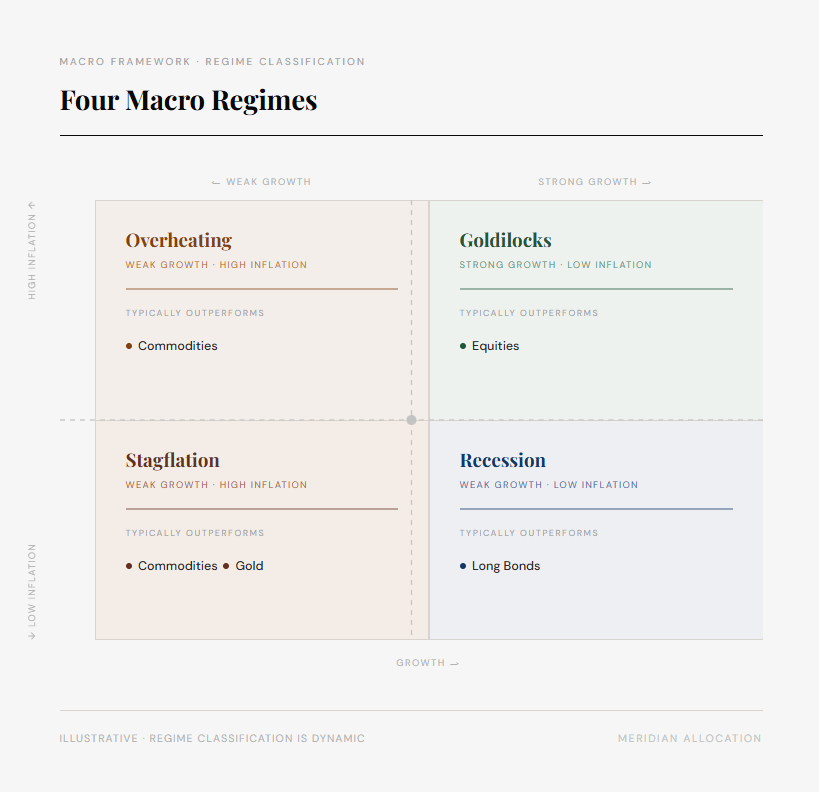
Every asset class performs best under certain economic conditions.
Equities tend to perform well during periods of stable growth and moderate inflation.
Long-duration bonds benefit when growth slows and inflation declines.
Commodities tend to perform best when inflation pressures rise.
These relationships are not precise, but they are persistent.
When a portfolio is heavily positioned for one macro environment, its performance becomes dependent on the duration of the environment.
When the macro environment shifts, assets that previously supported portfolio returns can begin producing losses simultaneously.
This is often the first stage of large drawdowns.
Hidden Concentration
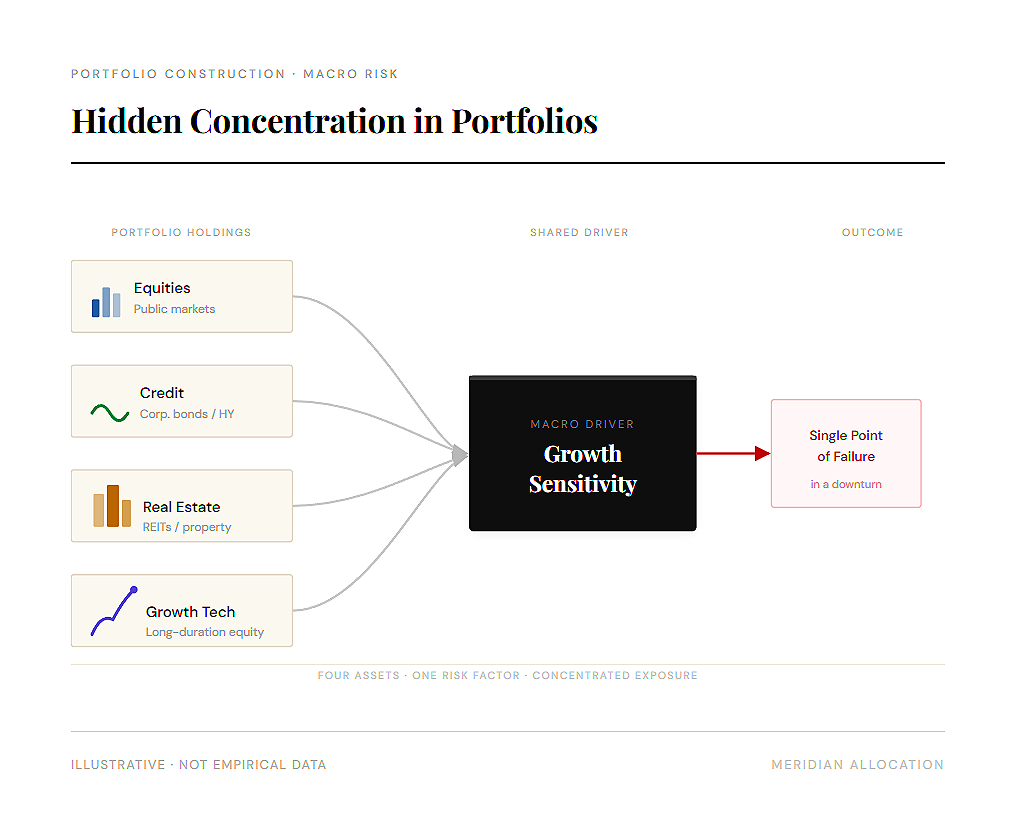
Many portfolios appear diversified because they contain multiple asset classes.
Equities, bonds, credit, commodities.
But diversification across assets does not guarantee diversification across factors that drive profit.
Multiple assets often depend on the same underlying forces:
Growth expectations
Inflation dynamics
Interest rate policy
Liquidity conditions
When several assets depend on the same macro driver, the portfolio may carry hidden concentration risk.
This concentration is often invisible during stable environments.
It becomes visible during regime shifts.
The Correlation Problem
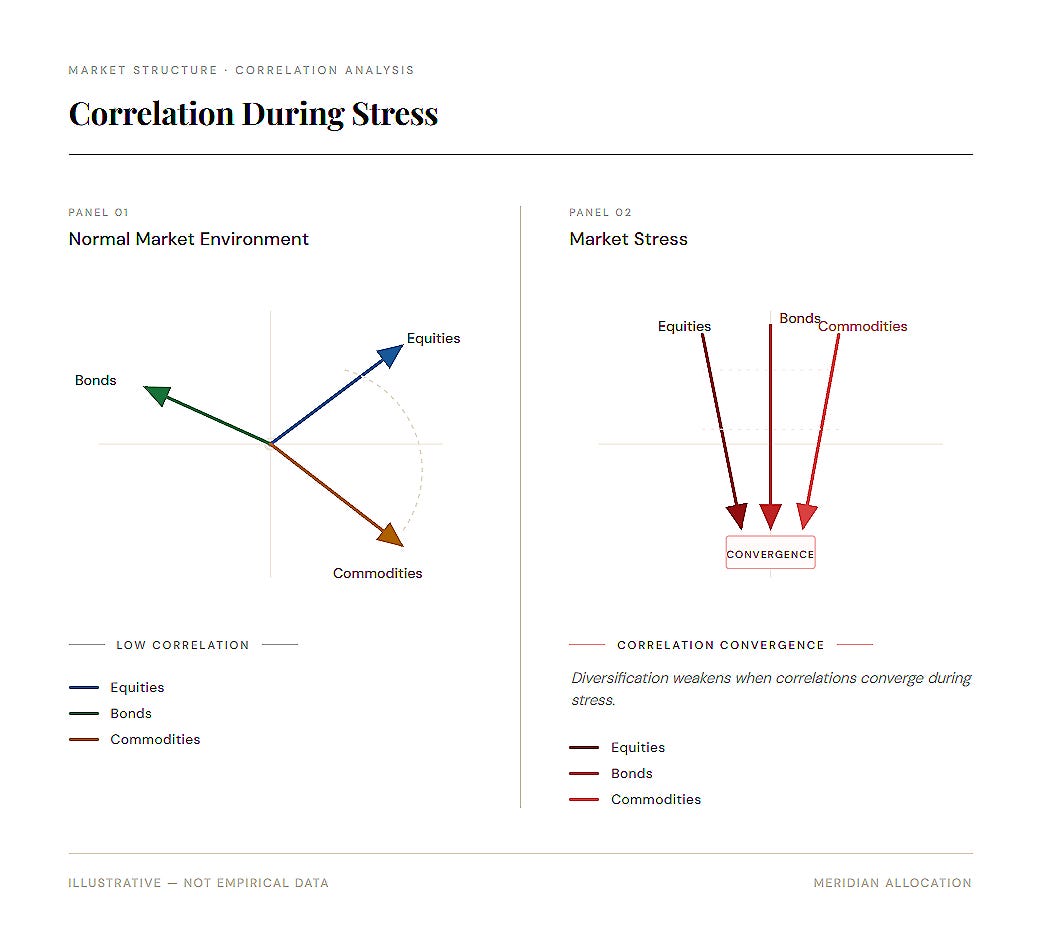
Diversification depends on assets behaving differently.
But correlations are not stable.
During macro transitions, assets that normally move independently can begin moving together.
Examples include:
Equities and bonds declining simultaneously during inflation shocks
Risk assets falling together when liquidity tightens
Defensive assets failing when real yields rise
When correlations converge, portfolios that appear diversified can begin behaving like a single concentrated position.
At that point, drawdowns accelerate.
Leverage and Forced Selling
Leverage increases returns during favorable environments.
It also amplifies losses.
More importantly, leverage introduces path dependency.
Losses reduce available capital.
Reduced capital forces deleveraging.
Deleveraging can lock in losses.
When forced selling occurs during stress, drawdowns deepen.
When leverage is applied to structurally fragile portfolios, losses can accelerate dramatically.
The Structural Nature of Portfolio Damage
Severe drawdowns rarely arise from a single cause.
They usually emerge when multiple structural pressures align:
a regime shift
hidden concentration across assets
rising correlations during stress
When these factors combine, losses can compound quickly.
Recovery then becomes dependent on the return of a favorable environment rather than on allocation.
The Real Role of Risk Management
If drawdowns were purely random, risk management would have limited value.
But because large losses are often structural, they can be reduced through disciplined allocation processes.
This requires recognizing the fact that:
economic environments change
asset relationships evolve
diversification must exist at the driver level, not just the asset level
Avoiding large drawdowns is therefore less about predicting markets and more about preventing structural fragility within the portfolio.
Preventing this fragility is the foundation of durable portfolio construction.
Meridian Allocation focuses on maintaining portfolio alignment with prevailing macro regimes, prioritizing capital preservation and drawdown control over return maximization.