
Why Static Diversification Fails Across Macro Regimes
Why fixed portfolios become fragile when growth, inflation, and correlations change

Most investors are taught that diversification is the foundation of portfolio resilience.
Own different assets.
Spread risk.
Avoid concentration.
Reduce drawdowns.
At a surface level, this is true. But in practice, diversification is often misunderstood.
Because diversification does not mean holding many things.
It means holding exposures that respond differently to changing economic conditions.
That distinction matters.
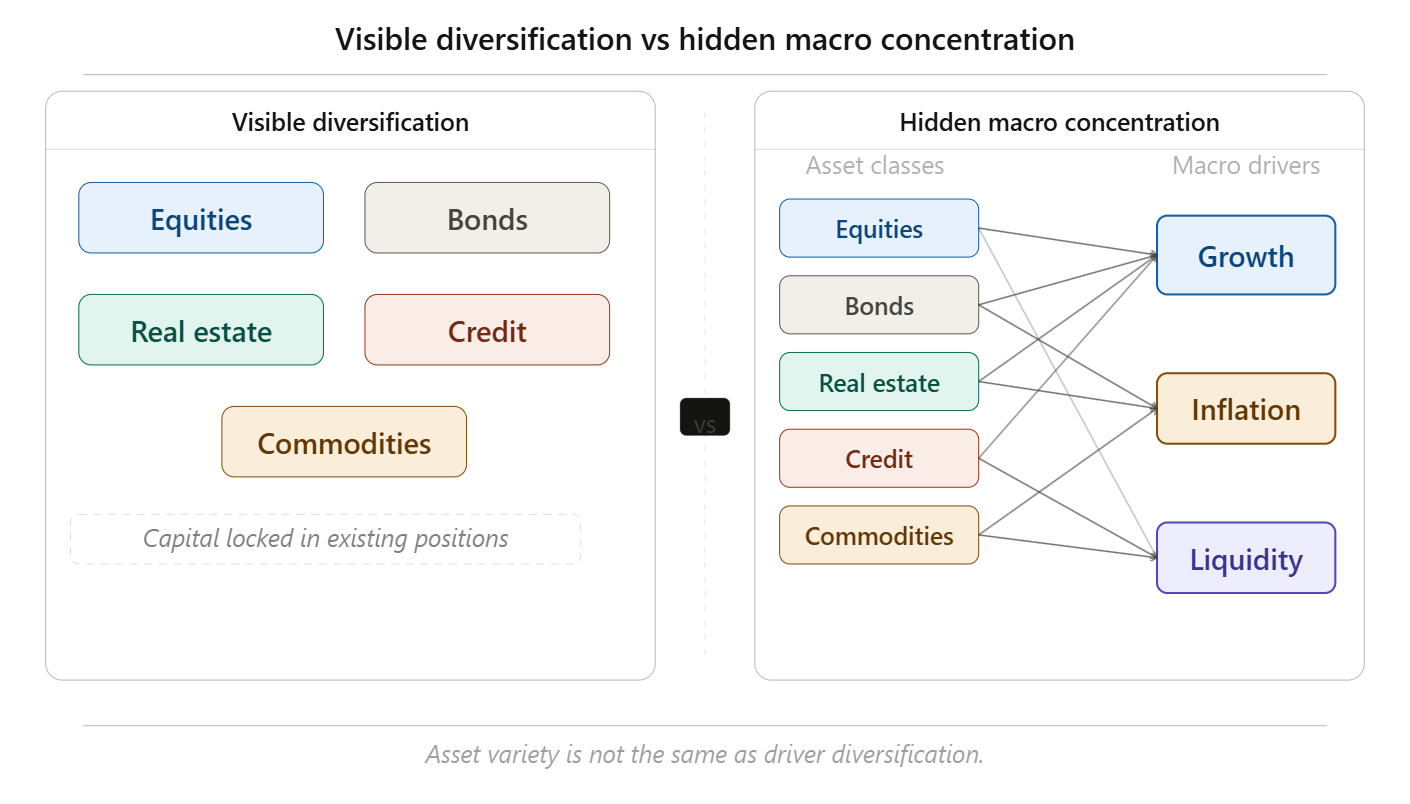
A portfolio can appear diversified by asset count and still remain dangerously concentrated underneath.
It can hold equities, bonds, commodities, real estate, and cash, yet still depend on one macro environment to work.
And when that environment changes, the protection investors thought they had can disappear quickly.
This is one of the biggest problems in portfolio construction.
Static diversification assumes that relationships between assets are stable enough for a fixed mix to remain robust through time.
They are not.
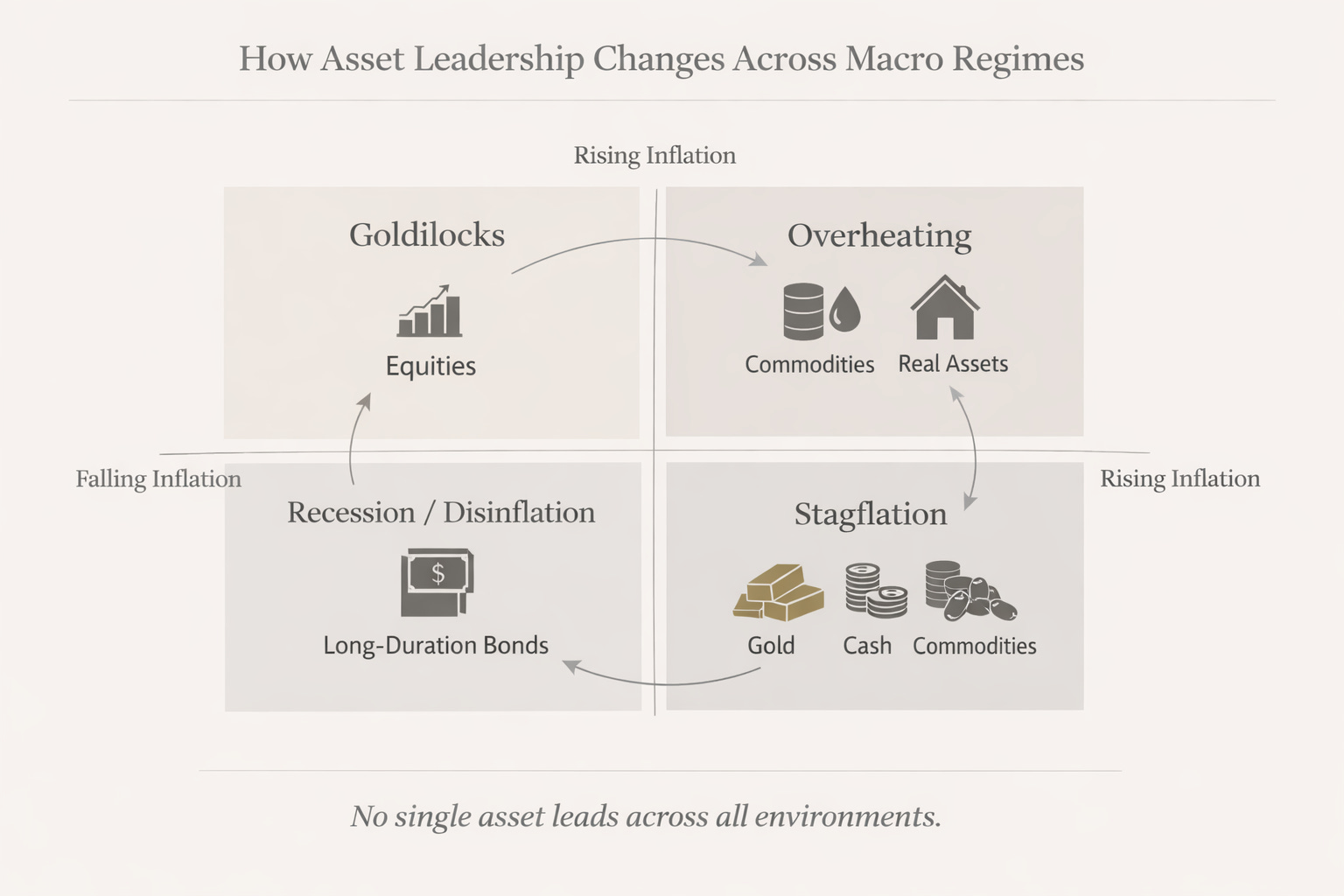
Asset behaviour changes across macro regimes.
Correlations change.
Leadership changes.
Risk transmission changes.
A portfolio that appears balanced in one environment can become structurally fragile in another.
This is why static diversification fails, not because diversification is useless, but because it lacks macro context.
The False Comfort of Asset Variety
Many portfolios are built on visual diversification.
A little domestic equity.
A little international equity.
Some bonds.
Some property.
Maybe some commodities.
Some cash on the side.
This feels prudent and in normal environments, it often appears to work.
But asset variety is not the same as driver diversification.
Two assets may be legally different, branded differently and still be exposed to the same underlying forces.
Equities and property may both depend on growth and liquidity.
Long-duration growth stocks and long-duration bonds may both be vulnerable to inflation repricing.
A portfolio can therefore look diversified while remaining concentrated in economic sensitivity.
This is the hidden problem.
True diversification must be assessed not by labels, but by what actually drives returns.
Portfolios Do Not Fail Randomly
Large portfolio losses rarely occur because many unrelated things suddenly go wrong at once.
They usually occur because exposures that seemed independent were actually linked by the same macro backdrop.
When that backdrop changes, the correlation structure of the portfolio changes with it.
Assets that previously diversified one another begin moving in the same direction.
Hedges weaken, and drawdowns deepen.
This is the structural exposure being revealed.
A static portfolio is built on the assumption that the future will be sufficiently similar to the past relationships used to justify it.
But macro regimes do not preserve those relationships consistently.
They reshape them.
That is why portfolio construction cannot stop at asset selection.
Asset Behaviour Is Regime-Dependent
Every major asset class has environments in which it tends to perform well and environments in which it tends to struggle.
Equities tend to benefit from improving growth, stable inflation, and supportive liquidity.
Long-duration bonds tend to benefit when growth weakens and inflation pressures decline.
Commodities tend to perform better when inflation is rising, supply stress is present, or real asset scarcity becomes more important.
Cash tends to look unattractive in benign periods but becomes strategically valuable when uncertainty rises or opportunity cost falls.
These are not exact laws but broad structural tendencies.
The key point is that asset returns are not independent from macro conditions.
They are shaped by them.
A fixed allocation assumes that a single portfolio mix can remain appropriate across materially different inflation, growth, and liquidity environments.
That assumption is far weaker than most investors realize.
When Diversification Works Best
Static diversification tends to perform best in environments where growth is positive, inflation is contained, and policy is stable.
In these periods, correlations remain moderate and drawdowns are manageable.
The problem is that investors often mistake a favourable regime for a permanent portfolio truth.
For example, the stock–bond relationship remained broadly supportive for much of the 2000–2020 period, reinforcing confidence in static diversification.
Investors observe a decade in which a fixed stock–bond mix behaved reasonably well and conclude that the structure itself is inherently robust.
Robustness, however, must be evaluated across regime change.
When Diversification Breaks
Diversification tends to fail when the macro driver that supported cross-asset balance changes sharply.
1. Inflation Repricing
When inflation rises persistently, assets that were previously buffered by falling discount rates may come under pressure together.
Equities can weaken as valuations compress.
Long-duration bonds can fall as yields rise.
Real assets may outperform, but many conventional portfolios are underallocated to them.
The result is not just poor performance in one sleeve.
It is simultaneous pressure across multiple core exposures.
This is one of the clearest examples of hidden concentration being exposed.
2. Growth Shock with Risk Aversion
When growth deteriorates quickly, equities, credit, cyclicals, and many economically sensitive exposures may fall together.
Even if government bonds rally, the protection may be insufficient if the portfolio is too growth-dependent overall.
Diversification helps less when too much of the portfolio is implicitly tied to the same economic engine.
3. Correlation Compression During Stress
In periods of stress, correlation structures can change rapidly.
Assets that usually move differently begin selling off together.
Liquidity becomes more important than valuation.
Investors reduce risk indiscriminately.
Crowded positions unwind.
At that point, portfolios are no longer being tested under average conditions.
They are being tested under stress conditions.
And stress conditions often reveal that diversification was shallower than it appeared.
The Core Structural Mistake
The central mistake in static diversification is treating allocation as a problem of balance rather than adaptation.
Balance matters.
But balance alone is not enough.
A balanced portfolio can still be wrong for the regime.
If inflation is rising and the portfolio is structurally long duration, balance will not save it.
If growth is deteriorating and the portfolio is loaded with cyclical beta, balance will not save it.
If stress causes correlation convergence, balance by asset label will not save it.
This is why portfolio construction must move beyond static weights.
The real objective is not to hold a permanently balanced set of assets.
It is to maintain a portfolio whose exposures remain coherent under changing macro conditions.
That requires a regime framework.
Macro Regimes Change the Meaning of Risk
Risk is often discussed as if it were a fixed property of an asset.
But in reality, risk is conditional.
An asset is not simply “risky” or “defensive” in all states of the world.
Its role depends on the regime.
Equities may be constructive in improving growth with contained inflation.
The same equities may become highly vulnerable in slowing growth with valuation compression.
Long-duration bonds may stabilize portfolios in disinflationary slowdowns.
The same duration exposure may become a source of damage when inflation expectations reprice higher.
This is why the same portfolio can feel diversified in one period and dangerously exposed in another.
The regime changed.
The portfolio did not.
Static Portfolios Are Implicit Forecasts
Many investors think a static portfolio is neutral.
It is not.
A static portfolio is an implicit bet that no macro environment will become sufficiently dominant to break the structure.
That is still a forecast.
Just an unacknowledged one.
A fixed mix says:
We do not believe inflation, growth, policy, or cross-asset correlation shifts will become large enough to require structural adjustment.
That may hold for stretches of time.
But when it does not, the portfolio has no mechanism to respond.
This is what makes static diversification fragile.
Its weakness is not simply that it can underperform.
Its weakness is that it lacks an internal process for adaptation.
What Must Replace Static Diversification
The alternative is not discretionary market timing.
It is not constant prediction.
And it is not reacting emotionally to headlines.
The alternative is a disciplined framework that recognizes three realities:
Asset behaviour is regime-dependent.
Cross-asset correlations are not stable.
Portfolio construction must adjust when the macro environment changes materially.
This leads to a different philosophy of allocation.
Instead of asking,
“How do I hold a little of everything?”
The better question is,
“How do I structure exposure so the portfolio remains resilient across changing growth and inflation conditions?”
That is a more serious portfolio construction question.
And it requires a more serious process.
From Diversification to Regime-Aware Allocation
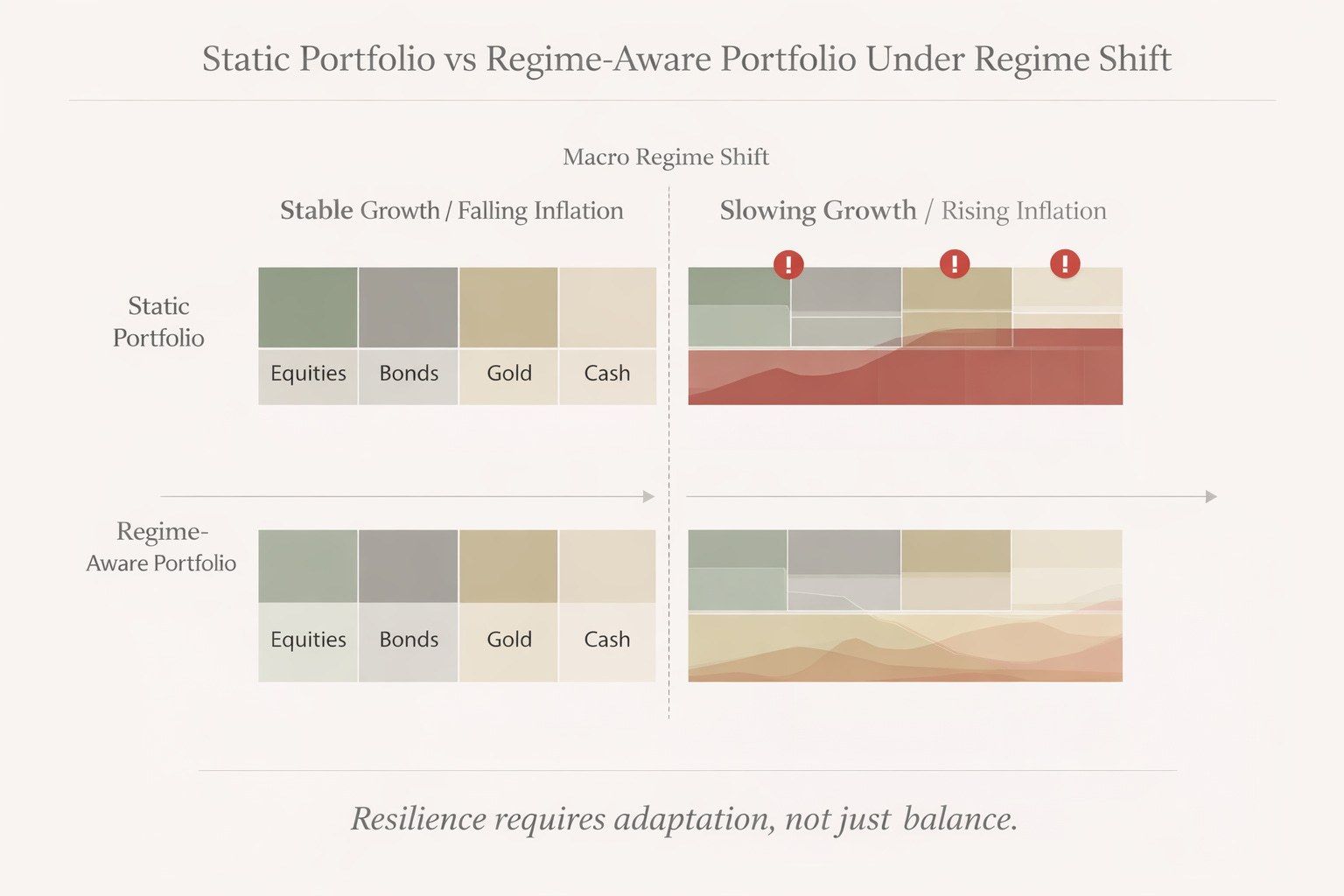
Regime-aware allocation begins from a simple premise:
Different macro environments reward different exposures.
Therefore, allocation should not remain fixed when the environment changes.
This does not mean overtrading.
It does not mean precision forecasting.
And it does not mean chasing every short-term signal.
It means building a framework that can identify broad macro conditions and adjust structural tilts accordingly.
When growth is improving and inflation is contained, risk assets may deserve greater weight.
When inflation is rising, duration-heavy exposure may need to be reduced.
When growth deteriorates, more defensive positioning may be justified.
When uncertainty rises, cash and risk control become more valuable.
This is not prediction in the sensational sense.
It is structural adaptation.
And structural adaptation is far more relevant to portfolio durability than static balance alone.
Why This Matters for Drawdown Control
The failure of static diversification is not merely an academic issue.
It is directly linked to large drawdowns.
When investors misunderstand diversification, they underestimate how vulnerable their portfolios are to macro transition.
They believe they are protected because they own multiple asset classes.
But if those assets are all exposed to the same shifting economic pressure, the protection is weaker than expected.
This is how drawdowns become surprising.
Not because the warning signs were impossible to see.
But because the portfolio was not being evaluated through the right lens.
Drawdown control therefore begins before the drawdown itself.
It begins in how the portfolio is designed.
A resilient portfolio is not just widely spread.
It is structurally aware.
Final Thought
Diversification fails when assets share the same dominant macro driver.
Diversification remains essential, but diversification alone is not enough.
A static mix of assets can reduce noise during stable conditions.
It can even look robust for years at a time.
But when macro regimes shift, static diversification often reveals its limits.
Serious allocation requires more than owning many things.
It requires understanding what those things are exposed to, how those exposures change across regimes, and when the portfolio itself must adapt.
True diversification is not about owning many assets.
It is about owning exposures that can survive when the environment changes.
And that difference sits at the center of Meridian Allocation.
Meridian Allocation is a rules-based macro allocation framework designed to maintain portfolio alignment with changing economic regimes, with a focus on capital preservation, structural diversification, and controlled drawdowns.